
A Billing System That Became a Bottleneck. We Made It a Platform.
How Adept Technologies re-architected a mission-critical billing platform for a global consulting group, decoupling legacy constraints and building for cloud-first scale
The Client
Our client is an enterprise-scale digital transformation firm based in Germany, with a portfolio spanning strategy consulting, advanced AI implementations, and cloud solutions. They serve more than 300 companies across multiple industries, supported by over 3,000 employees across Germany and international offices. Their work is analytically rigorous, technically demanding, and delivered under the kind of exacting standards that German engineering culture expects.
The irony was that the system managing their own internal billing operations was doing none of those things.
The Challenge: A Legacy System Holding a Modern Business Back

There is a particular kind of technical debt that accumulates quietly over years and then announces itself all at once. For our client, that moment arrived when they examined their internal billing platform and realised that what had once been fit for purpose had become a cage.
The system had been built on a legacy framework that had grown increasingly rigid as the business around it scaled. Business logic was buried deep inside backend code, meaning that even minor changes to user-facing workflows required full engineering releases. The user interface demanded multi-step processes and constant context-switching, creating cognitive load that slowed daily work across the entire finance and operations function. And critically, the architecture was never designed for the cloud-first, globally distributed model the company now needed to operate at.
The consequences were compounding:
- Every UI change carried release risk because business rules and interface code were tightly coupled.
- Backend tickets and rework were frequent, driven by logic that was invisible at the interface level.
- The platform could not scale reliably to support the organisation's global expansion ambitions.
- Daily billing operations were slower than they should be, creating internal friction that accumulated into real operational cost.
This was not a cosmetic problem that a redesign could fix. It required a fundamental re-architecture — separating concerns, extracting business logic, building a deployment pipeline that could deliver change safely at scale. It required, in short, structured modernisation expertise from a team that understood both the engineering and the business logic underneath it.
Our Approach
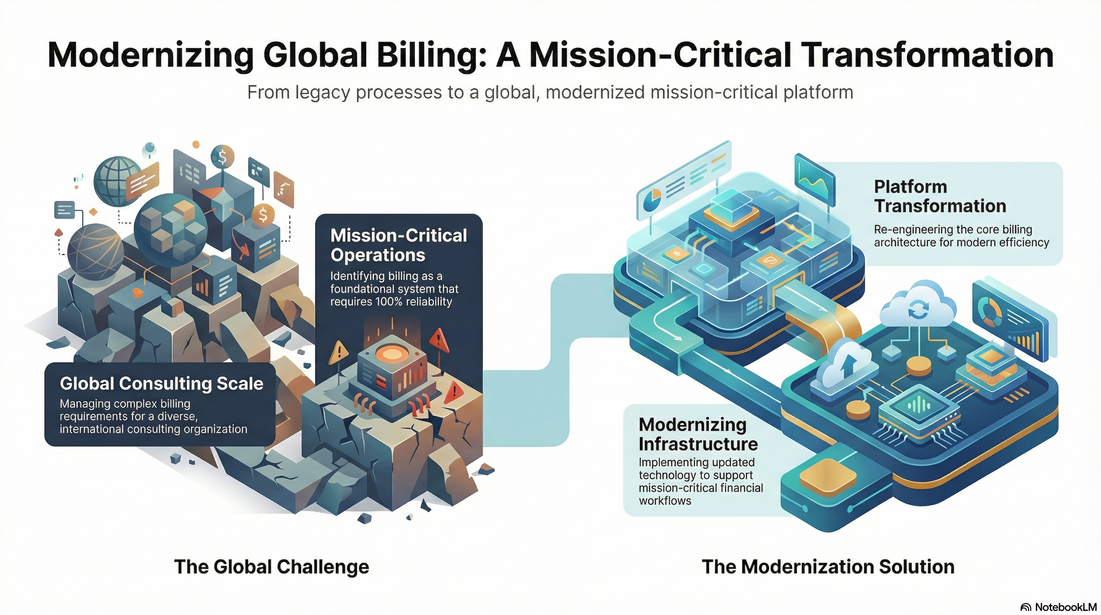
Our approach was grounded on a principle the client's German engineering teams valued and could immediately recognise — architecture clarity before feature delivery. We did not start by building new screens. We started by understanding the business logic embedded in the existing system and designing the separation that would make every future change faster and safer.
Clean architecture and separation of concerns
- Angular front end delivering an efficient, low-friction user experience decoupled from business logic.
- Java microservices with clearly defined REST APIs separating UI decisions from backend rules.
- Documented interfaces and data contracts enabling safe, predictable change without the risk of cascading failures.
Disciplined delivery and QA from day one
- Feature-level acceptance criteria and a formal scope table agreed before development began.
- Unit and end-to-end regression testing embedded throughout the build, not applied at the end.
- Weekly demos providing visible progress and early feedback loops with client stakeholders.
Risk-managed rollout
- Pilot testing and feature flags to reduce disruption while building internal trust in the new platform.
- Smoke tests and focused QA at every release to minimise go-live risk.
- CI/CD pipeline for cloud deployment — predictable, automated, and built for scale.
The Results
| Area | Before Adept | After Adept |
|---|---|---|
| Architecture | Tightly coupled UI and business logic | Fully decoupled: Angular front end, Java microservices |
| Change risk | Every UI change required a full backend release | Interface changes independent of business logic |
| Billing task speed | Multi-step, high cognitive load workflows | Streamlined flows reducing time to complete core tasks |
| Backend incidents | Frequent tickets and rework | Significantly reduced after interface-visible rules and robust APIs |
| Deployment | Manual, high-risk releases | Automated CI/CD pipeline with smoke tests |
| Cloud readiness | Not architected for cloud scale | Platform built for wide cloud usage and global expansion |
The Impact
-
Faster billing operations
Streamlined user flows and decoupled business logic reduced the time to complete core billing tasks, freeing the finance and operations teams from the friction that had accumulated in the old system.
-
Fewer incidents and less rework
With interface-visible rules and robust REST APIs, the volume of backend tickets and rework dropped significantly. Engineers could change what needed to change without worrying about what else they might break.
-
Predictable, confident releases
The CI/CD pipeline, combined with smoke testing and focused QA gates, transformed deployments from high-anxiety events into routine operations. The team could release more often, with less risk, and with the kind of confidence that only comes from a system built to be changed.
-
A platform built to scale
The re-architected platform is now positioned for wide cloud usage and global expansion — not just technically capable of scaling but architecturally designed for it. The client's original ambition, deferred by a legacy system that couldn't keep up, is now achievable.
Why This Worked
Three principles made the difference between a modernisation project that delivers and one that drifts.
- Architecture first: separating concerns made every subsequent change faster and safer. The engineering discipline applied at the design stage paid compound interest throughout the build.
- Quantified acceptance: clear scope, documented criteria, and QA gates eliminated the ambiguity that causes scope creep and late-stage rework in most complex enterprise projects.
- Risk-managed rollout: pilots and feature flags built internal trust before full deployment, ensuring the organisation had time to adapt alongside the platform.
Frequently Asked Questions
What does legacy billing system modernisation involve?+
It typically involves separating tightly coupled UI and business logic, rebuilding on modern frameworks such as Angular front ends with Java microservices, documenting interfaces and data contracts, and implementing automated CI/CD deployment pipelines. The goal is a system that can be changed safely, quickly, and at scale.
How long does it take to re-architect an enterprise billing platform?+
Timelines depend on complexity and scope. For a system of this scale, serving 300+ client companies across multiple industries, a structured re-architecture spanning discovery, build, QA, and deployment typically runs over several months. This engagement followed a phased approach from kick-off through to post-launch stabilisation.
Why use a software development outsourcing partner for enterprise modernisation?+
A specialist outsourcing partner brings structured engineering discipline, embedded QA, and the ability to scale delivery capacity without the overhead of full-time hiring. For complex modernisation projects, the combination of architecture expertise and disciplined delivery methodology is often what separates successful outcomes from stalled projects.
Modernising a Legacy Platform?
Talk to us about re-architecting your system for cloud-first scale without disrupting live operations.
Talk to us at adept-techno.com