Kenya's Outsourcing Moment Is Already Here
But Not in the Way We Expected
Reflections from stakeholder conversations across Kenya's outsourcing and digital services ecosystem, what's changing, what's being overlooked, and where we see the real opportunity.

Introduction to Kenya's Outsourcing and Digital Services Landscape
Since the beginning of this year, we've been part of ongoing conversations across Kenya's outsourcing and digital services ecosystem, with clients, industry peers, policymakers, and operators. This piece reflects musings, observations and our perspectives on outsourcing in Kenya.
There is genuine optimism in Kenya's outsourcing sector right now. It shows up in policy discussions, in the interest from international clients, and in operators investing in their digital services capabilities. That optimism is warranted, but it deserves to be stress-tested from a leadership perspective.
Because the opportunity that's arriving in outsourcing in Kenya looks different from the one that most of the industry has been preparing for. And that gap matters.
What clients are buying has changed

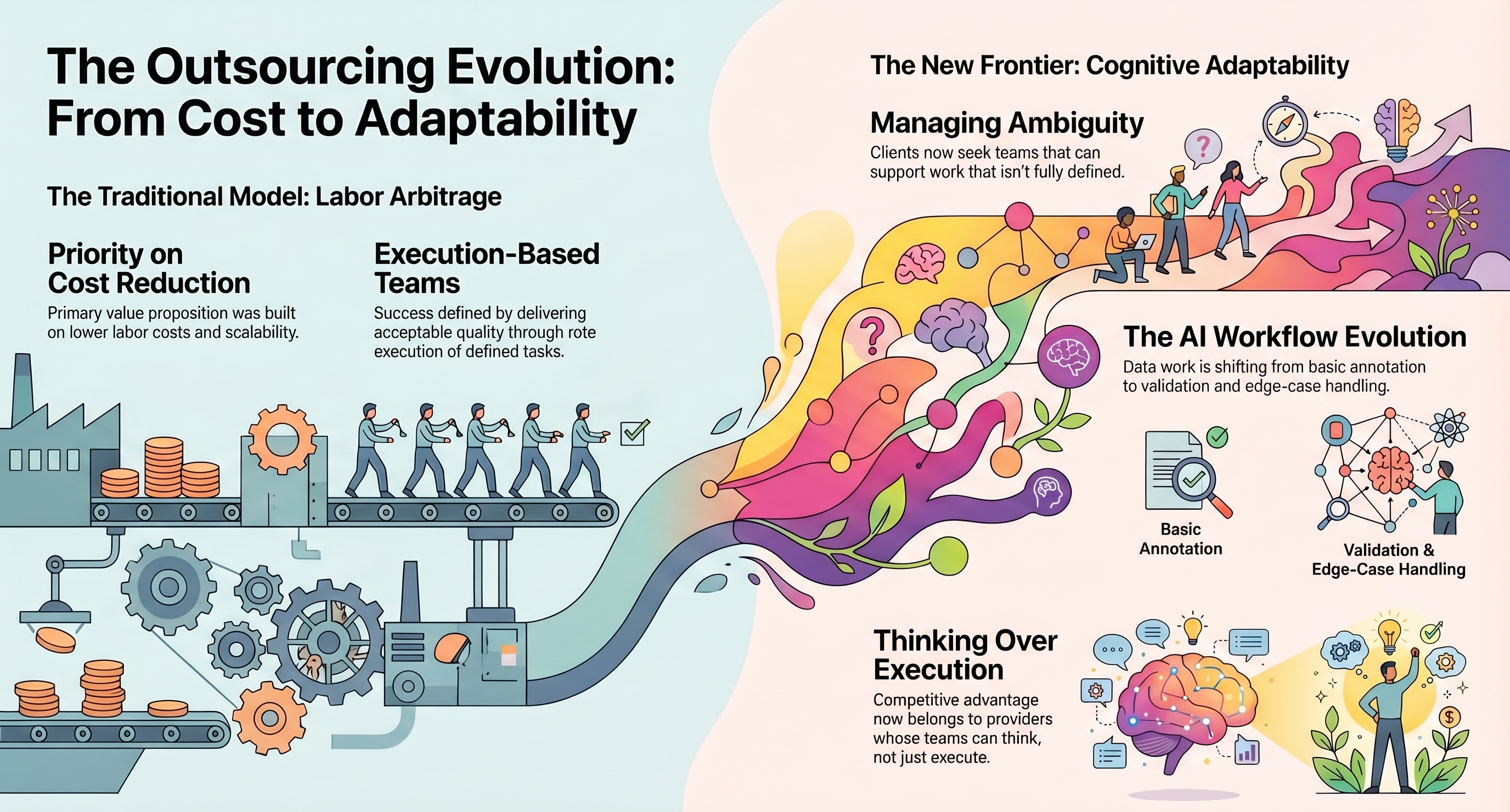
For years, the outsourcing value proposition in Kenya has been built around cost: lower labour costs, acceptable quality, scalable teams. That still matters. But in conversation after conversation with international clients this year, something has shifted in digital services expectations.
The question is no longer just "can you do this at lower cost?" It's increasingly shifting toward adaptability, ambiguity handling, and evolving workflows.
- Can your teams handle ambiguity?
- Can your workflows evolve when the brief changes?
- Can you support work that isn't fully defined from day one?
In other words, the competitive advantage in outsourcing is slowly migrating from cost to adaptability. And that requires a fundamentally different kind of leadership readiness.
We see this most clearly in AI-related work. Basic data annotation volumes fluctuate, but the work doesn't disappear. It evolves into validation, edge-case handling, quality control, and ongoing model support. These functions require teams that can think, not just execute. The providers who understand that shift are already positioning for it. Those who don't risk preparing for a market that's already moving on.
The workforce model question isn't settled
One of the themes that keeps surfacing in outsourcing in Kenya, sometimes explicitly, more often in the background, is the question of how work should be structured and contracted.
The reality is, some roles demand structured, full-time engagement. Others are project based, flexible, and more fluid in nature. Clients are increasingly designing workflows with that flexibility in mind. At the same time, workers are looking for stability, career progression, and predictability.
Policymakers are, understandably, trying to create frameworks that protect workers while enabling the industry to grow. It's a tension without a clean resolution, and the conversations we've been part of suggest that everyone is still working through it.
Local Operators in Kenya’s Outsourcing and Digital Services Sector Have Real Advantages That Aren't Being Fully Leveraged
The presence of large global outsourcing firms in Kenya brings real benefits: international credibility, established client pipelines, and scale.
But it also creates a dynamic worth naming honestly.
Global players tend to have a stronger voice in shaping both market perception and policy direction. And yet local operators have the opportunity to serve the work that's emerging because they are:
- Relatively more agile in how they structure and adapt delivery.
- Better placed to take on less defined or rapidly evolving work.
The challenge for local firms isn't capability, it's visibility and coordination. For Kenya's outsourcing ecosystem to grow in a way that's genuinely sustainable, there needs to be more intentional inclusion of locally led operators, not just as delivery subcontractors, but as architects of how the industry develops.
That's a conversation we're committed to being part of.
The AI narrative is being misread

What AI is doing is reshaping the outsourcing market, not eliminating it. New categories of work are emerging just as quickly as old ones are being automated: monitoring model outputs, managing exceptions, maintaining data quality over time, and providing the human judgment that AI systems still depend on.
The real challenge, and where we spend a lot of our own strategic thinking, is whether providers can evolve their service offerings fast enough to capture those emerging categories. That's less about hiring at scale. It's about learning at scale. Building teams that can move with the work as it changes form.
The gap between strategy and execution remains wide
At a high level, there's broad consensus on the country's outsourcing fundamentals: strong and engaged talent, favourable time zones, competitive cost structures, and a growing track record with international clients. The macro case is well understood.
What's less well understood, and what comes up persistently in the conversations we've had, is the gap between that strategic position and consistent delivery at scale. Infrastructure, talent development, and market access don't always move at the same pace. And winning work is only half the challenge. Building the internal systems that can sustain and grow that work over time is where the opportunity lies.
Conclusion: Leadership Will Define the Future of Outsourcing in Kenya
This, more than anything else, is where Kenya's outsourcing future will be decided. Not in policy white papers or keynote addresses, but in the daily leadership decisions about how teams are developed, how digital services are structured, and how quickly organisations adapt when the nature of the work changes.